
We have become good looking people, not good people.
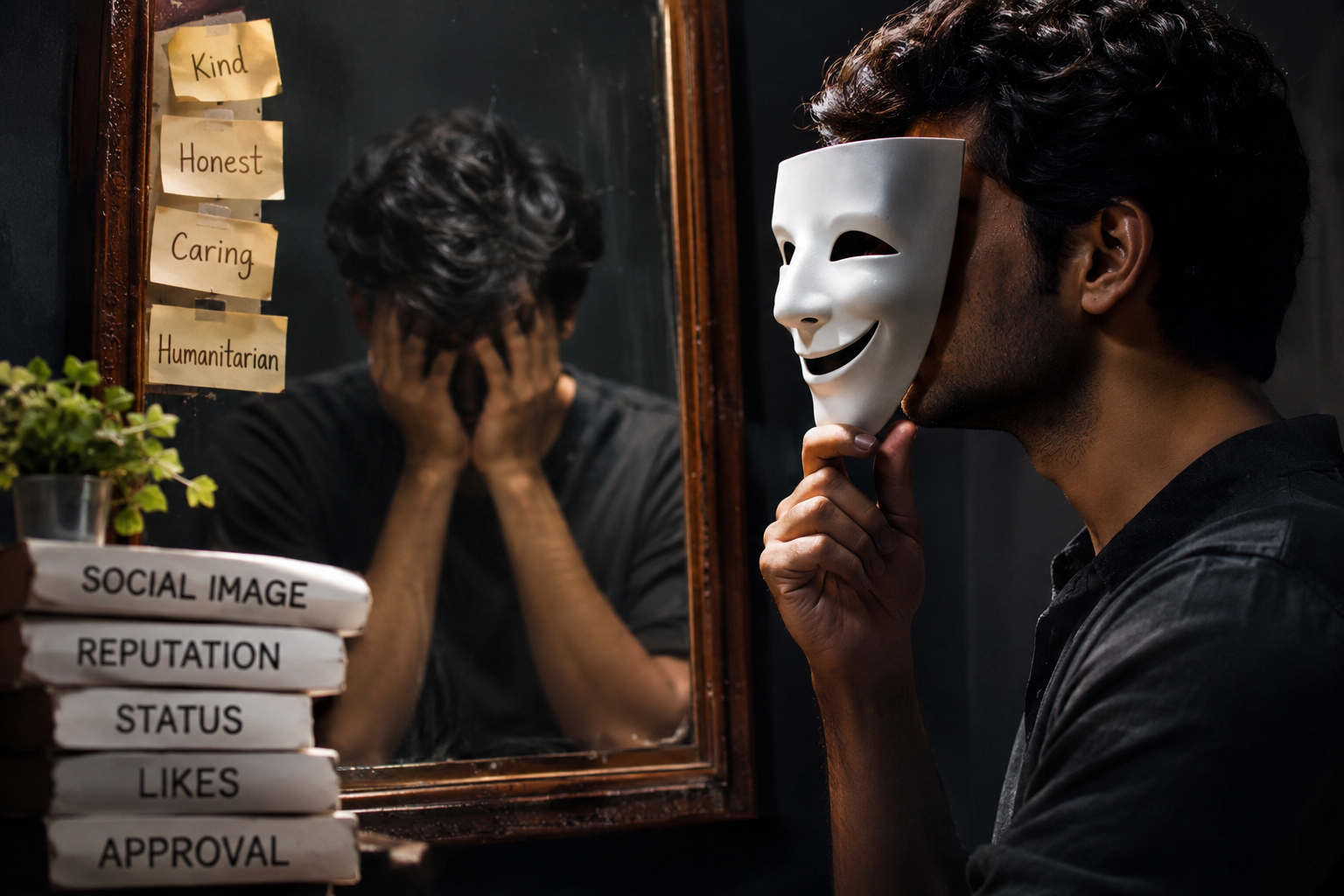
We have become good looking people, not good people
Today's man is more concerned about looking good than becoming good. We talk a lot about honesty, humanity and morality, but we often forget those values in our personal behavior. We have made goodness not a character but a part of our social image. The question is, are we really good people or just pretending to be good?
Have you ever wondered why in today's times people try to look good more than to be good?
We write big messages on humanity, honesty, women's respect and helping the poor on social media. But when it comes to adopting these values in our life, our behavior changes. We teach honesty to others, but compromise principles for our own benefit. We talk about respect, but forget how to treat someone weaker than us.
Why this double character?
1. Goodness is no longer a character, it has become a performance
It is human to help a poor person, but is it necessary to prove one's greatness by showing that help in front of the camera? There is nothing wrong in sharing pictures of help on social media. Others may also get inspiration from it. But when the purpose of help becomes to enhance one's image rather than to help the needy, then we should question our intentions. The problem is not in the camera, but in the mentality which loses the motivation to do good without the camera.
2. Are we honest or just afraid of getting caught?
Ask yourself a question. If no one was watching us, our wrongdoings would never be discovered, and there would be no possibility of punishment, would we still do the right thing? The real meaning of honesty is that despite having the opportunity, we should not choose the wrong path. We are often more afraid of getting caught than of doing the wrong thing. This fear could be of law, of society or of losing reputation. But morality is that which keeps us on the right path even without any monitoring or fear.
3. Social media has made even goodness a competition
Today we not only want to be happy, we also want to show our happiness. We not only want to be successful, we also want to showcase our success. It is easy to share a post on an issue, but difficult to devote time to its solution. It is easy to express sympathy on someone's grief, but difficult to stand with him in his difficult times. Is our sensitivity limited to screens only?
4. True character is shown by dealing with the weak person
Being humble in front of a superior is not a proof of goodness. The real test is when the other person cannot give you any benefit. How do you talk to your subordinate employee, labourer, sweeper, driver or any poor person? If our respect and behavior changes after seeing the status of the other person, then we should consider our morality. Because a man's true identity does not lie in how he treats powerful people, but in how he treats weak people.
5. Why do we consider our mistakes as right and the mistakes of others as crimes?
We are angry with the lies of others, but call our lies a compulsion. We call the selfishness of others wrong, but give our own selfishness the name of practicality. When someone else breaks the rules it is wrong, but when we do the same we have many reasons. This double standard is the biggest weakness of our morality. We advise others to change, but do not try to change ourselves.
If there were no cameras in the world, no social media, no one to admire, would you still be as good a person as you try to appear to the world today? Remember, your true identity is not what the world knows about you, but what you do when the world is not looking.


Comments (0)
No comments yet — be the first to comment.